


"We all know that the most expensive part of an OR isn't the robot. It's not the technology. It's an OR that sits idle."
An idle operating room costs between $60 and $200 a minute. Until recently, Linnette Johnson, SVP and Chief Clinical Operations Officer for AdventHealth's Central Florida Division, had no reliable way of seeing where those minutes went.
For a long time, AdventHealth produced a schedule that dictated what should happen in the OR, and manually produced a chart of what they recalled happened in the OR.
But there was no record of what actually happened in the OR.
The 11-minute gap that no one could see
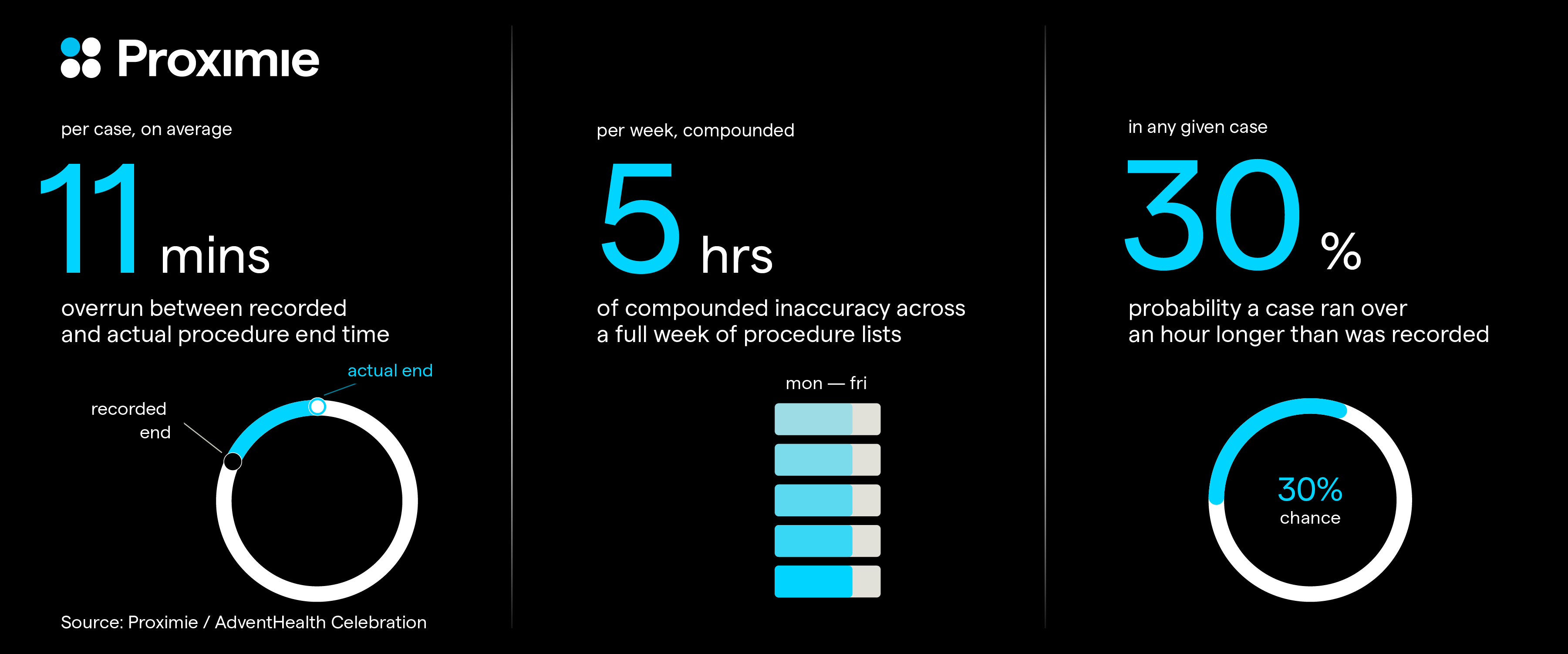
When Proximie's surgical intelligence sensors started ambiently capturing the room, every event as it happens, there was a gap of eleven minutes between what was being logged manually and what was actually taking place in the OR.
And those eleven minutes, repeated across a full day of lists, adds up to a compounded inaccuracy of almost five hours a week.
Five hours not lost to surgery but to a record that didn’t match reality; five hours that were actively making it more difficult to make informed decisions and plan each day’s procedures efficiently.
And the discrepancy is even more pronounced under pressure. "So we put wheels out, we were still in the room, we were still wrapping up, there were things that were happening." In any given case, there was a 30% chance it ran for an hour longer than what was recorded. Behind every one of those cases is, as Johnson puts it, "somebody's loved one."
Crucially, these variations and inaccuracies in manually recorded data are not a result of bad intentions, but of siloed systems that were never designed to talk to each other, and staff charting from memory in the gaps between seeing their patients. They're the result of a missing piece of the puzzle: a tool that makes it possible to record the truth of what's happening in the OR.
Linnette Johnson put it plainly:
"If the record is incomplete, every decision we make after that inherits that error."
A dashboard built on an inaccurate record doesn't just show the wrong number, it sends the next decision in the wrong direction entirely. As Johnson puts it, an unreliable record "pushes the day back," and "you can't create learning patterns because the data is skewed." Incorrect data becomes the shaky foundation for staffing plans, block time, and capacity conversations. Even with the best intentions in the world and the most talented surgical teams on the planet, decisions made on poor foundations are liable to produce poor outcomes.
"We all know that the most expensive part of an OR isn't the robot or technology, it's an OR that sits idle," says Linnette. It costs $60–200 a minute, and as she puts it, "every minute we recover through these smarter processes and better technology is actually a minute we can give back to patients through access."
A fix the OR team never has to think about
"The record is manual," Johnson explains. Circulators chart as they go or after the case, one hand on a keyboard wheeled into the room, the other still attending to the patient. Physicians document afterward. And the data that does exist is not joined-up: "The robot's got data. My trays have trackers and data. But none of it coincides or speaks to each other. Studies will show you there are 400,000 inaccurate data points per OR based on these variables."
The consequence is felt long after the case closes. "How many records over the last 34 years have I pulled to determine, did the case stay robotic? Did it convert to open?" This is what surgical intelligence is designed to replace and that’s not just the inaccuracy, but the hours spent trying to correct for it.
Johnson was specific about what would and wouldn't fix it, requiring that any solution operate on the basis of requiring no manual input, making no change to the existing workflow, and being co-designed with vendors, all while remaining securely integrated with hospital systems and private by design.
First case starts on track. Everything after was drifting.
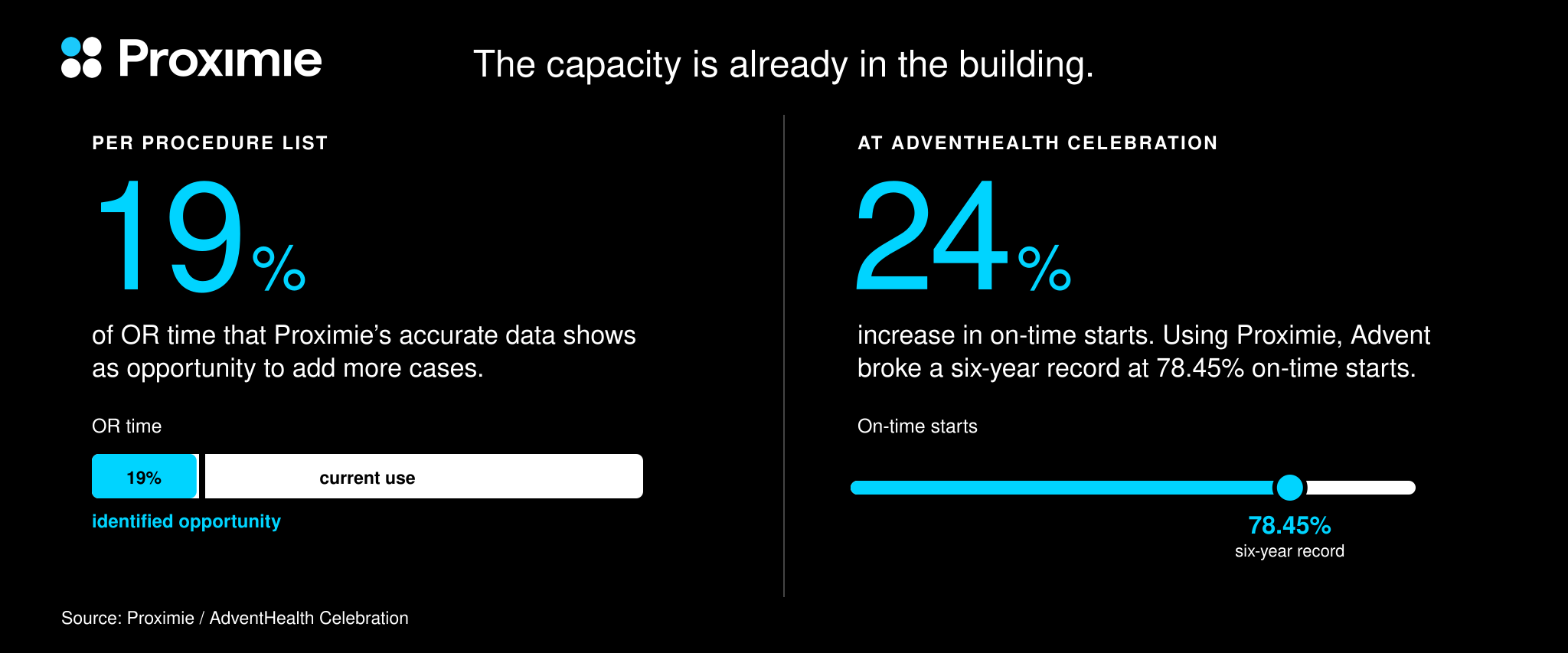
The most telling detail wasn't the gap itself but where the gap lived. First-case starts at AdventHealth were already strong, starting on schedule 90–100% of the time. But to-follow cases, the second, third, fourth case on a list, none of these had ever cracked 78% in six years. Every OR knows this pattern instinctively: the first case of the day gets everyone's full attention, and the rest of the list starts drifting further and further behind schedule without anyone really realising how or why.
What the data did was make that drift visible for the first time, instead of leaving it as something everyone suspected but nobody could quite point to. "For the first time in six years, we actually reached 78% on our two-follow cases," Johnson says, "because the technology showed us that what we thought might take an hour may take an hour and a half", which is enough to plan the next case, and the physician, around it properly.
19% more OR time, and not one new OR
Building a new OR costs millions, if the capital is even there to spend. But according to Johnson, Proximie's surgical intelligence platform identified existing resources already sitting inside AdventHealth's rooms, waiting to be used.
Once the record caught up with reality, AdventHealth found that there was time in the OR that could be recovered. And used.
"Proximie's accurate data identified that there was 19% of OR time that was presenting an opportunity to grow our schedule." Not by adding new ORs, more staff, or longer days, but through capacity that already existed, sitting inside a working day nobody had been able to see clearly enough to reclaim.
What an OR looks like when it sees itself
That vision only holds if surgeons trust what they're looking at. "Surgeons want to know where the data came from. Is it Switzerland? Is it accurate?" Proximie's surgical intelligence platform answers that question before it's asked; ambient, objective, and integrated with hospital systems.
"Imagine a system where the room actually sees itself," says Johnson. "Turnover times, on-time starts, everything comes across the room and it collects it. The note that writes itself. You're speaking your timeouts, and they're writing themselves. You're not having to input those data points. Safety's not left to memory, or 'if I feel like doing it', you're prompted. And every case actually teaches the next."
Underneath that vision sit four things Johnson says have to be true first. Here is her own foundation for AI-ready infrastructure:
“I don’t just want to be data-rich,” Johnson says. “Most of us have a lot of data…we don’t know what to do with the data.”
What’s needed instead is closer to a colleague: “An AI to help us say, hey, if you did this, this would add more volume or more cases.” The point isn’t replacement. “AI augments the team. It doesn’t replace the team, so that we can deliver the safe care that our mission calls for us to deliver.”
The OR of today, not the OR of the future
AdventHealth didn’t set out to prove a theory about data. They set out to see their OR clearly. What they found was that most of what they thought they knew about their own ORs hadn’t been true for years, and that surgical intelligence, applied to the gap between the schedule and the room, was the key to unlocking the extra capacity they'd been looking for all along.
In Johnson’s own words:
“This is not the OR of the future. This is the OR today. We have the data and we have the partners. The question is: will we act on it?”


.avif)