


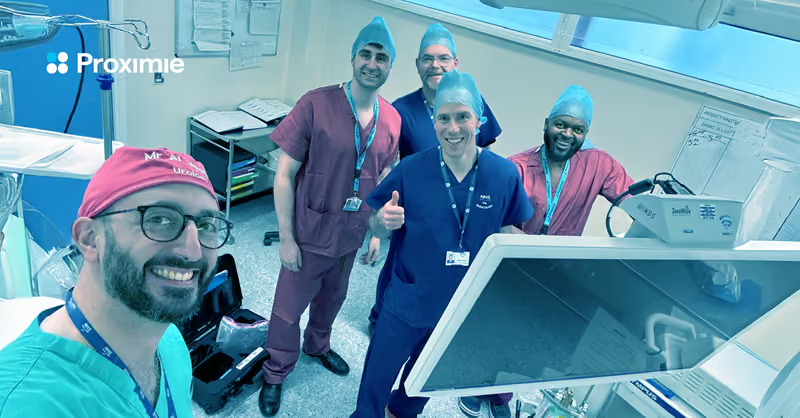

Customer Success Manager, Arsham Khayatpoor, discusses the secrets to a successful partnership, the agility of Proximie to scale across healthcare systems, and some of the recent cases that inspire him.
No two days in this job are the same. On Monday I might be in Sheffield for a first Proximie demo. On Wednesday I could be in a theatre in Coventry. By Friday I'm following up with a surgeon in Bulgaria over WhatsApp.
I'm a Customer Success Manager at Proximie, which means I’m the person hospitals and OR teams work with day in, and day out. My focus is on the Surgical Suite, Proximie's technology that enables surgical teams to remotely connect, collaborate and share knowledge in real-time, whilst also giving teams the ability to record and archive any of their procedures. I’m responsible for onboarding, training, site visits, troubleshooting and renewals. The works. Once the transformation leads have brought a new hospital live, that's when I step in.
The secret to doing it well is simpler than most people think. It's about understanding their pain points. Why did they invest? What do they want to use Proximie for? I guess one of the most interesting things of implementing Proximie is that every one uses it differently.
It’s never a copy and paste, as every centre uses Proximie differently.
Some use it only for proctoring. Some are building a compliance library. Others, like the gynaecology team I spent time with recently in Sheffield, discover a use case during the trial that nobody anticipated. In their case, the potential to run masterclasses for doctors in training. I don’t think this particular use-case would have come if I wasn't physically present in the room when it happened, which is one of the best parts of my job.
I think presence matters more than any email or phone call. When a new site goes live, I like to be on-site for the first few cases. Not just to make sure the technology works, but to start building the relationships that will carry everything forward.
The ones that stick are the relationships where the communication flows both ways. NHS teams are busy, things slip, but when a customer keeps you in the loop, shares what's working and what isn't, that's when you can actually help. Its a two way partnership and the best collaborations work when you’re both pushing each other to problem solve.
One of the best examples of Proximie in action was during the Pleven case. The team in Bulgaria did something remarkable, connecting a surgeon with colleagues in China over 7,000 kilometres, from a taxi. They didn't tell us in advance and at the time they didn't need our technical help. They just did it, and then came back and said, "We did something pretty cool, has anyone done this before?" That wasn't us, it was very much them but I think it says a lot about what good training and a trusted relationship can unlock. But more than that, it says so much about Proximie and how intuitive the platform really is. This is a customer that feels genuinely confident with the technology and that’s ultimately what we’re always working towards.
There's another case I find myself telling people about. In the UK, during an orthopaedic procedure, the company rep supporting the surgeon on the day was a stand-in who didn't have the answers the surgeon needed. Rather than delay the case, we used the headset and PX lens to bring the company's senior stakeholders into the room remotely and immediately. The surgeon held up two instruments. The manager on the call said which one. The case went ahead without a problem. If Proximie hadn't been in that room, I genuinely don't know what would have happened.
What I keep coming back to is something I heard from Proximie’s work in Kenya and this idea that Proximie is like a comforting presence on your shoulder. You're not always using it. You're sometimes not always aware of it, but it's there. And just knowing it's there changes everything. Surgeons are extraordinary people, but they're human, and being human means sometimes you need a hand.
That's what gets me out of bed. Being in a theatre, seeing a case go well, knowing that the technology played some small part in helping a patient; there's nothing quite like it.
I’m biased but the Surgical Suite still has an instant and undeniable power. When people see a consulting surgeon scru- in digitally from across the world, or a trainee watch their first live procedure as if they were the one operating, they immediately understand the benefit. That's very rare in medtech but it’s something I’m continually surprised by.


.avif)
