
There’s a misconception that “efficiency” in surgery is about working faster. At Guy’s & St Thomas’ NHS Foundation Trust (GSTT NHS), the story is different. The team has found a way to work smarter with what they already have.
Proximie (AWS Partner) delivers this capability on Amazon Web Services (AWS), supporting Guy’s & St Thomas’ NHS Foundation Trust (AWS Customer).
Efficiency isn’t about working harder or faster. It’s about maximising available surgical time so that more patients can be treated safely, while ensuring surgical teams aren’t working in an environment that pushes them beyond their limits.
In an NHS still carrying an elective backlog of over seven million patients in the UK, every recovered minute is vital; it can be the difference between a patient being seen, or slipping onto the waiting list of an already overstretched healthcare system.
For staff, meanwhile, each recovered minute counts towards relieving the pressure on surgical teams, so they can work more effectively, more happily and - ultimately - finish on schedule to get home on time.
Mr Andrea Billè, Consultant Thoracic Surgeon at GSTT NHS, has seen first-hand the benefits of data-driven visibility through Proximie’s Intelligence Suite, enabling them to unlock the hidden capacity on robotic thoracic surgery lists, generating a domino effect of positive impact for patients, staff, and the healthcare system.
"Since we started this efficiency program with Proximie,” said Mr Billè, “we haven’t had any cancellations in our theatre. Of course, there may be cancellations for clinical reasons, but cancellations for overrunning or for not being efficient are pretty much at zero now."
When minutes become capacity
Robotic thoracic surgery lists are complex. They’re tightly scheduled, resource-heavy, and often filled with patients who can’t afford delays. A single cancellation can ripple across weeks of already-blocked OR time, pushing treatment back and increasing anxiety for patients waiting for treatment.
Using the Intelligence Suite, the GSTT NHS team were able to gain a clearer view of where their OR time is really going - not as a blame exercise, but as a practical way to protect capacity and reduce avoidable overruns. It helps teams consistently pinpoint where improvements can be made, track whether changes are working, and keep refining over time.
Seeing the OR, end to end
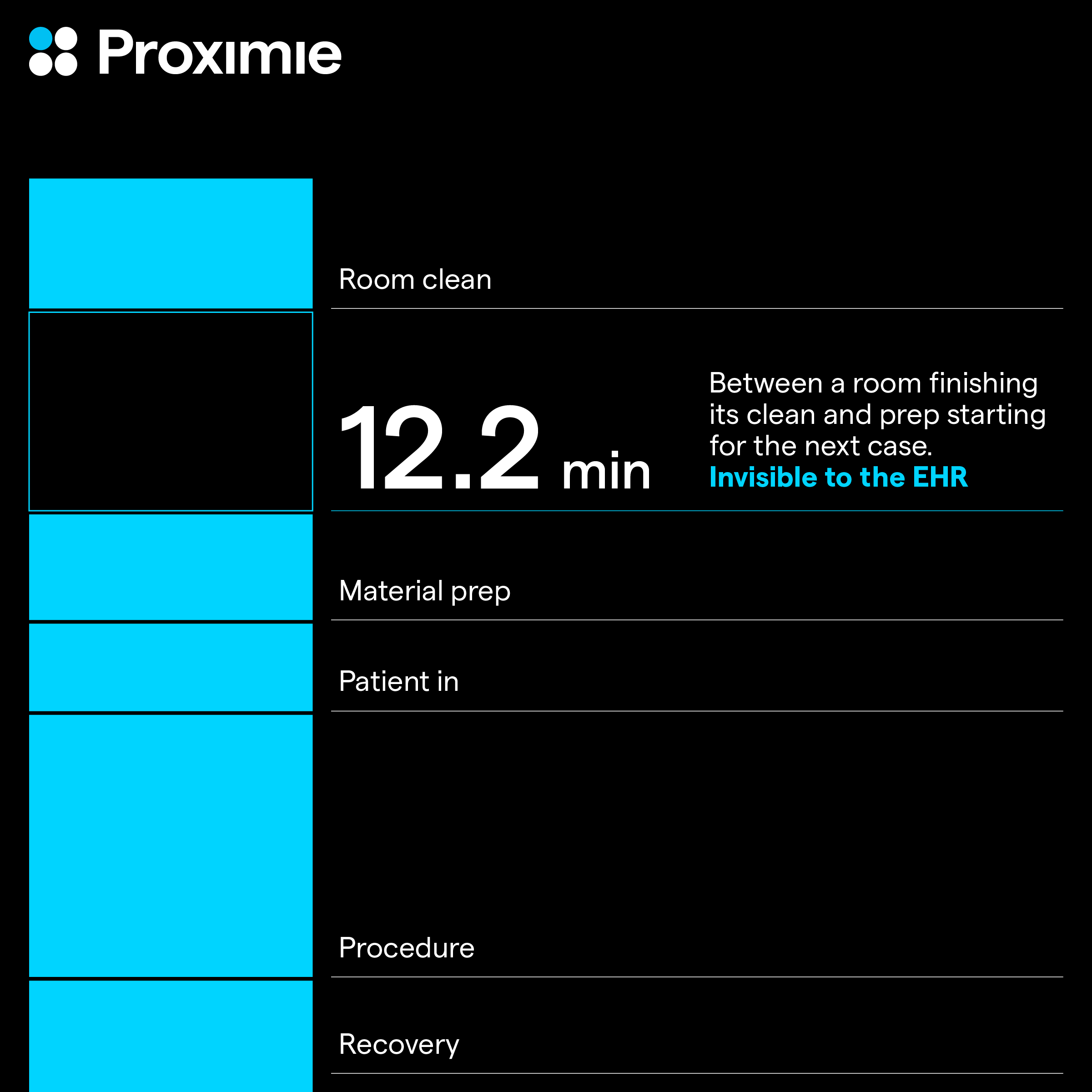
Proximie’s Intelligence Suite uses ambient data collection and AI-driven real-time analysis to create visibility across the operative pathway, giving teams a clearer picture of flow, bottlenecks, and opportunity time. The platform uses AWS-native AI services to generate these real-time insights.
At GSTT NHS, Proximie was implemented across two NHS robotic thoracic surgery lists, enabling the team to identify small, targeted optimisations to cumulative effect. The result wasn’t theoretical; it was measurable.
“Access to accurate, data-driven insights translated directly into efficiency gains of an average of 20 minutes per procedure,” said Mr Billè. “By identifying small but meaningful workflow improvements, we were able to save almost an hour across each surgical list – enough time to complete an additional case per day without extending theatre hours.
“These results reflect tangible, real improvements that can help reduce cancellations, make better use of NHS resources, and ultimately allow more patients to receive the care they need sooner. As we head into the busy winter months, optimising theatre efficiency in this way is increasingly vital for maintaining surgical capacity and supporting the wider health system.
“Most of the time saved came from in and around the procedure, because having objective metrics that show what's happening in the anesthetic room and the operating room gives you an idea on how the time can be optimised, and how the flow of the patients can be optimised in order to save time.
“In our case, across two lists and five days a week, we are potentially able to increase our capacity by an additional 10 patients every week, or 40 additional patients every month.”
“Treat more” is a patient story, not a productivity metric
Reducing cancellations and delays isn’t just about targets or timetables, it’s about avoiding weeks of additional waiting time that can be distressing for patients and especially risky for those on cancer pathways. True efficiency means patients being seen and treated quickly and effectively, improving outcomes where they’re needed most.
One recent case highlighted in the GSTT NHS case study involved a 60-year-old patient whose quality of life had been significantly impacted by severe breathlessness following a fall. He had been on a waiting list for over 18 months, until he was referred by his local hospital to GSTT NHS, where he received his surgery in a matter of weeks due to the hospital’s increased capacity
After his surgery - facilitated by a Proximie-enabled list - his symptoms improved dramatically and he was able to return to work.
“Help more” includes the people delivering care
An efficient OR treats more patients while also helping the workforce sustain high performance without burning out.
The connection between overruns, morale and retention - particularly for OR teams - is undeniable. When late finishes become the norm, staff fatigue rises and retention suffers. When lists become more predictable and overruns reduce, the difference in the room is felt across the healthcare system; the OR is calmer, and there is improved camaraderie that results in more cohesive, happier teams that are able to perform at their best.
“Seeing more” also means learning more
The GSTT NHS team has used Proximie for years, and its value extends beyond throughput. For trainees, it becomes a learning tool. Recorded cases can be reviewed ahead of operating sessions, helping to understand techniques and build confidence. On a wider scale, consistent data creates the possibility of benchmarking performance across lists, teams, and sites, so good practice can be shared - not siloed.
The story at GSTT NHS isn’t “AI replaces clinicians.” It’s AI revealing the hidden shape of the surgical day, so clinicians can make better decisions, earlier and with less friction.
“What this technology delivers,” says Dr Bille, “is making the surgeon's life easier and making surgery safer, supporting teams in pushing for the best possible outcome to a greater number of patients.”
When you recover 20 minutes per case, you don’t just create time. You create options:
- the option to treat an additional patient,
- the option to reduce cancellations,
- the option to finish on time more often,
- the option to protect morale and retention.
That’s the true power of an efficient OR. See more. Treat more. Help more. All in a way that supports the people and systems patients rely on most.