.avif)
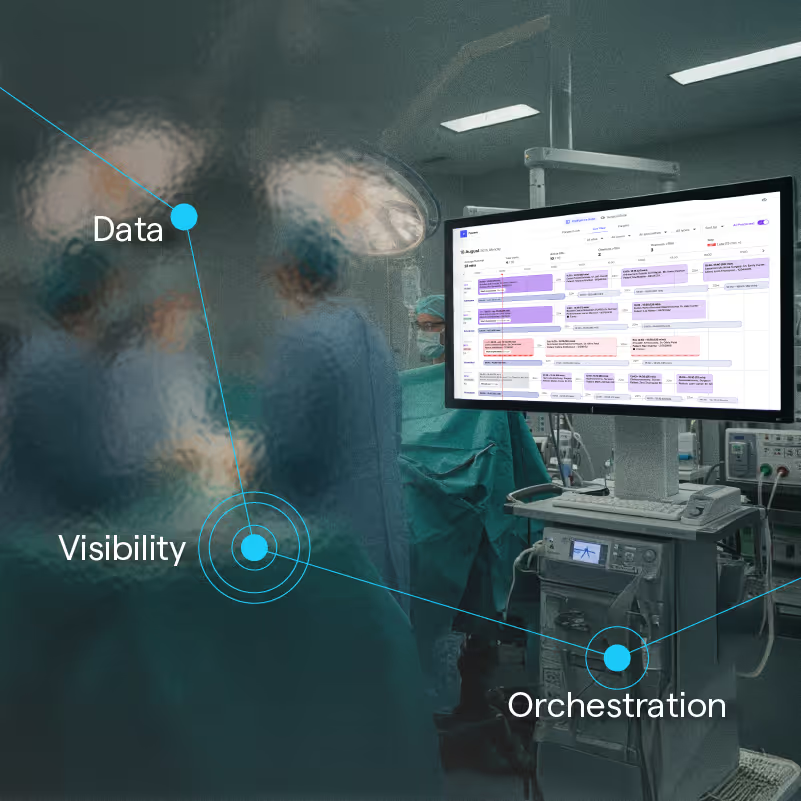
There is a high cost for every minute lost during surgery. Minutes lost to an unforeseen late start. Minutes lost hunting for missing equipment. Minutes lost because prep happens in a queue, not in parallel. These moments may not feel significant in isolation, but across a list, a week, a year… those lost moments accumulate at the expense of the most valued attributes of every healthcare system: efficiency, capacity, productivity.
In 2025, Proximie rejected the concept of “more data for data’s sake” and embraced one simple idea: if you can see how your operating room (OR) really runs, you reveal the objective truth of how minutes are lost - and, more importantly, how they can be saved. With this knowledge, healthcare teams gain the ability to recoup one of their most valuable resources: time.
Time with their team. Time with their patients. And at the end of the day, time with their families and friends.
“The operating room doesn’t need another dashboard,” says Dr. Nadine Hachach-Haram. “It needs real-time intelligence embedded into the workflow, so the day can run with less friction, and surgical teams can get time back to treat more patients.”
Unlocking real-world efficiency in 2025
Throughout 2025, Proximie partnered with three healthcare systems in the US and UK to measure how OR time is being lost, and how - using the right interventions - efficiencies could be unlocked.
Over two different continents, across a range of specialities, and under a variety of clinical pressures, we saw the same patterns repeating time and again.
19%-25% of OR time is “opportunity time”
Through three separate applications of Proximie, our OR intelligence revealed that 19%-25% of total OR time was being lost to unnecessary variation, delays, and workflow friction - time that, with the correct interventions, is entirely recoverable.
When clinical teams from the three healthcare systems could see what would happen when these avoidable delays were reduced, the outcome was consistent across the board: enough time saved for one additional procedure per OR, per day, without extra headcount, and without extending hours. These aren’t hypothetical predictions, these are changes that healthcare systems are already making in order to drive additional OR throughput in their respective system. More time, greater efficiency, and the capacity to treat more patients.
This constitutes a tangible, significant improvement in efficiency that optimises clinical performance while improving access to care.
The deeper truth: most delays aren’t clinically inevitable
Every patient is different and every procedure has its own rhythm, so variation is an intrinsic element of surgery. But one of the most important insights from Proximie’s work this year is that much of the variation that makes lists run late isn’t driven by clinical complexity - it’s driven by process.
In one setting, only 15% of time variation was attributed to clinical factors, while 55% came from avoidable process inefficiencies. In other words: a major proportion of lost time occurs before procedure start and end. All of which is good news, because it is in those areas where improvements can be most realistically achieved without compromising care.
The patterns made visible by connected ORs
Once you can have a detailed overview of the surgical day in its entirety, the looming occurrence of bottlenecks and inefficiencies is no longer hidden. Instead, they reveal themselves as patterns.
Here are five that showed up across all three healthcare systems.
1) Preparation happening sequentially instead of in parallel
Many lists still rely on critical steps happening one after another: patient prep, anaesthesia readiness, materials set-up. When those workflows are better synchronised, the gains are immediate.
In one US healthcare system, we revealed that improved coordination could reduce total OR time by up to 28% (vascular) and 12.5% (bariatric). These significant ‘opportunity times’ can make real and tangible improvements to patients’ lives. And the lives of otherwise time-poor and overstretched healthcare teams on the frontline of care.
2) Materials friction (“where is it?” time)
It sounds basic, but it’s everywhere: disorganised case carts, missing instruments, unnecessary walking between sterile tables and equipment. In one setting, this created up to 16 minutes of variation in materials prep.
In another, materials prep averaged 32.4 minutes after wheels in, and delays in acquiring equipment were seen in 30% of subprocesses.
3) The human synchronisation gap
Clinical teams are experts at the work itself. But the choreography around a case - who needs to be where, and when, can still be complex.
In one example, surgeons arrived 30 minutes before first incision in 20% of cases, but entered the OR less than five minutes before start in 30% of cases. Delayed staff entry disrupted workflows in 20% of subprocesses. These are marginal when viewed in the moment, but the broader look highlights the marginal gains healthcare systems can unlock when they have access to the bigger picture.
4) Turnover time that isn’t really turnover
Turnover becomes a catch-all bucket for everything that didn’t happen quite smoothly enough between cases. And even in high-performing environments, there’s often more idle time than anyone expects.
In the UK thoracic setting, 76% of turnover time was identified as inactive. In another setting, observed turnover ranged from 12 to 60 minutes. Again, these are significant time delays that are, in most instances, unnecessary and when viewed through a different lens, each moment is a presentable opportunity to claw back time and gain OR efficiency.
5) The domino effect
Small delays don’t stay small. Once the schedule starts slipping, the delays start snowballing.
In one setting, 70% of turnover variation could be predicted by time of day, and every hour later that surgery started increased turnover by 3.24 minutes on average. Every additional 10 minutes of turnover time was also associated with anaesthesia taking two minutes longer during the next case.
This is exactly why visibility matters: the earlier you can see slippage occurring, the more chance you have of preventing it.
Turning insight into impact
Data only matters if it changes the day. In the two US systems, feasibility modelling showed that the efficiency opportunity translated into one additional case per list, per day.
In the UK, a thoracic unit went further. They tested workflow changes guided by Proximie’s insights, compared milestones before and after, and concluded those changes could open the door to an extra procedure per list, with no additional OR time required.
When you start thinking at scale, the implication is clear: a recovered hour isn’t just an hour. It’s a patient who doesn’t wait, a list that doesn’t tip into overtime and a team that receives the time they need to achieve clinical excellence. Or even, for the team to simply get home on time.
2026: From visibility to orchestration
Proximie’s work in 2025 proved the size and consistency of “opportunity time”. The focus of 2026 will be making those gains repeatable, thereby reducing the burden on teams who are already stretched. That means going deeper on real-time performance visibility across the full surgical day, as well as moving towards workflow orchestration: smarter coordination that removes needless admin and avoids “phone tag” between teams.
“Our vision is an intelligent co-pilot in the OR - not replacing surgeons, but amplifying them,” says Dr. Nadine Hachach-Haram. “If the room can understand what’s happening, it can help orchestrate the next steps and that means reduce admin, reduce delays, and make the whole day run more smoothly.”
The connected OR isn’t just another dashboard; it’s a system for identifying patterns that provide opportunities to save time - time for treating more patients, protecting clinical teams and making each day of surgery run as smoothly and successfully as possible.
That’s what Proximie can do, in any OR, anywhere in the world.
This is Surgery.